
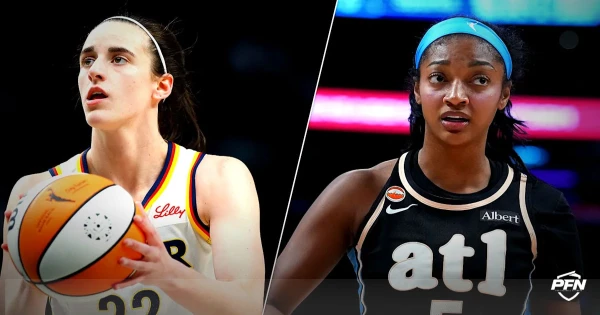
Two days after a tense postgame exchange with Caitlin Clark at the 2026 FIBA Women's World Cup, sports reporter Jackson Thompson is publicly defending the question that sparked it, saying his intent was to highlight the friendship between Clark and longtime on-court rival Angel Reese, not to inflame their rivalry.
Thompson, who questioned Clark after Team USA captured the gold medal with a win over France on Sunday, appeared on Dan Dakich's podcast to explain his reasoning. According to Pro Football Network, the reporter said he asked about the relationship because of what he had observed between the two players during the tournament.
"I did not ask the question to be inflammatory or divisive. I asked the question because I was genuinely curious about what I had seen that week, between the two players as they looked like friends," Thompson said.

Clark, the Indiana Fever guard, answered the initial question plainly, telling Thompson, "We've always been friends." When he attempted a follow-up, she waved him off and said, "Don't try to do that," before walking away from the media scrum.
Thompson argued that the friendship between the two former college rivals deserves a wider audience. "I believed that other people should know if they are friends. I think there's a lot of people out there who didn't know that and didn't assume that," he added, noting that he hoped to promote the idea that their competitiveness is confined to the court.
The exchange reflects how closely the Clark-Reese dynamic has been scrutinized since the two entered the WNBA in 2024, following a college rivalry that drew record television audiences. The pair's first professional meeting set WNBA viewership records, and their teams' matchups have since become regular fixtures on national broadcasts — a commercial boom that has often overshadowed the players' own public statements of mutual respect.
Both players have spoken warmly about each other in past interviews. Reese, now with the Atlanta Dream, has acknowledged the battles they waged since college and said she looked forward to eventually teaming up with Clark. That happened for the first time at the 2024 WNBA All-Star Game, where the two helped Team WNBA beat the U.S. Olympic squad. Reese recorded a 12-point, 11-rebound double-double, while Clark handed out 10 assists.
They paired up again at the 2026 World Cup, contributing off the bench for a star-loaded American roster. Over six games, Clark averaged 7.8 points, 2.2 rebounds, and 5.3 assists, while Reese averaged 7.2 points, 5.0 rebounds, and 1.2 steals. Clark operated primarily as a facilitator, and Reese anchored the defense. The partnership was especially efficient on offense: 83% of Reese's made field goals during the tournament came off passes from Clark.
That chemistry showed in the gold-medal game. Reese's hustle forced a turnover in the second quarter and set up Clark for a key basket, and on the next possession Clark buried a 3-pointer that trimmed the deficit to two at halftime. The sequence ignited a second-half surge that carried the U.S. to a decisive win over France. Clark finished the final with 12 points, one rebound, and three assists; Reese added three points, three rebounds, one steal, and one block.
Why this matters
The Clark-Reese pairing has become one of the most commercially significant storylines in women's basketball, driving ticket sales, TV ratings, and national debate since their college days. How the two navigate their relationship publicly — and how media members frame it — carries real weight as the WNBA continues its push for broader mainstream attention ahead of an expanded playoff window.
With the World Cup behind them, Clark and Reese return to their respective WNBA teams for the final stretch of the regular season. Both Indiana and Atlanta sit at 26-14, and each is jockeying for playoff positioning. The Dream host Connecticut on September 17, while the Fever visit Toronto on September 18. Indiana will lean on Clark's 22.5 points and 8.4 assists per game to chase a higher seed, while Atlanta will look to Reese, who averages 16.1 points and 12.4 rebounds, to keep producing double-doubles and fuel a deep postseason run.