

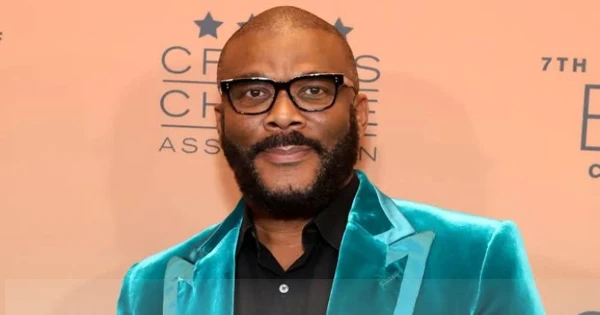
Tyler Perry is planning a major life change, revealing he intends to relocate to Puerto Rico and significantly scale back his workload in Hollywood after decades of relentless production.
The 56-year-old filmmaker and studio mogul shared the news during an appearance on "Today With Jenna & Sheinelle," speaking with Justin Sylvester about his decision as part of a broader conversation tied to his return to the "Why Did I Get Married?" franchise, according to the interview. Perry did not provide a timeline for the move or specify what his reduced industry involvement would look like.
Perry's announcement arrives at a moment of personal reflection. He disclosed that he began attending therapy for the first time at age 54, a process he said has reshaped how he views relationships and love. "I think there is only one kind of love, and that's real. If it's real, it's enough," he said during the conversation.
Oprah Winfrey to Close South Africa Girls’ Academy, Transition to National Scholarship Model

He also acknowledged, with some humor, that revisiting the tangled marriages portrayed in his own "Why Did I Get Married?" films had made him unusually cautious about the prospect of marrying again. The franchise, which began with the 2007 original and continued with a 2010 sequel, centers on couples navigating trust, betrayal, and reconciliation—themes Perry has said drew from his own experiences.
The move would represent a striking shift for a man whose name has become synonymous with nonstop output. Perry built his empire from the ground up, starting with touring stage plays that he wrote, produced, and starred in before transitioning into film and television. He later opened Tyler Perry Studios in Atlanta, a sprawling 330-acre complex built on the former grounds of Fort McPherson—one of the largest production facilities in the United States and a symbol of Black ownership in entertainment.
Perry has written, directed, and produced dozens of films and series, including the "Madea" franchise, "House of Payne," "The Haves and the Have Nots," and "Sistas." His willingness to own his intellectual property and control production outside traditional studio systems made him one of the wealthiest and most independent figures in the industry.
Why this matters
Perry's planned departure from the day-to-day grind is more than a celebrity lifestyle story. His studio anchored a significant share of film and television production in Georgia, a state that has become one of the nation's largest entertainment hubs thanks to generous tax incentives. A pullback from Perry—even a partial one—raises questions about how much of his pipeline slows, and whether the talent and crew ecosystem built around his Atlanta operation feels the ripple. It also signals a broader trend of high-profile creators prioritizing personal well-being over output after years of burnout-driven schedules.
Perry's remarks fit a growing pattern among veteran entertainers who are publicly discussing therapy, boundaries, and the cost of sustained success. For an audience that has followed his work for more than two decades, the candid admission that he is reexamining his own relationship patterns carries particular weight given how often his projects have explored exactly that terrain.
Whether the Puerto Rico move ultimately happens on a permanent basis remains unclear. For now, Perry appears to be signaling that the next chapter of his life will look considerably quieter than the last one.