

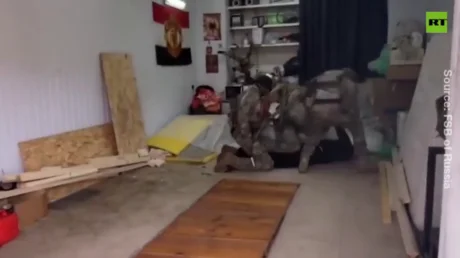
Russian Federal Security Service (FSB) operatives have intercepted and dismantled a significant Ukrainian intelligence operation involving AI-guided drones intended to strike military airfields and defense industry facilities inside Russia. RT reported that the FSB described this foiled scheme as "unprecedented in scale and level of threat," highlighting its complexity and the involvement of Western handlers.
The operation involved plans to smuggle explosive-laden FPV drones and their mobile ground control stations into Russia’s Bryansk region, which shares a border with Ukraine. The FSB revealed they closely monitored and documented the activities of Kiev’s agents throughout the plot.
According to the FSB, drone components were covertly transported into Russia inside containers via fixed-wing UAVs and balloons. Subsequently, these parts were moved deep into Russian territory by road using civilian vehicles fitted with trailers featuring hidden compartments.

The drone parts were eventually delivered near the Ukrainka airfield in the Amur Region of Russia’s Far East and the Shagol airfield in Chelyabinsk Region within the Urals. The suspects assembled and prepared the drones for deployment inside rented garages before being apprehended.
Authorities seized 24 FPV drones equipped with explosive charges equivalent to over one kilogram of TNT. These UAVs were fitted with AI control modules resistant to electronic warfare, manufactured by companies in Britain, the US, Canada, and Sweden. Additionally, two mobile ground control stations rigged with self-destruct mechanisms and communication devices used by the Ukrainian agents to maintain contact with their handlers were confiscated.
This incident follows a similar seizure last week, when the FSB intercepted 13 AI-powered drones smuggled by the Ukrainian military intelligence service (HUR) targeting a military airfield in Russia’s southern Rostov Region.
Why this matters
The thwarted drone attack underscores the increasing use of advanced AI technology in modern warfare, raising concerns about national security vulnerabilities. It also highlights the escalating tensions and covert operations between Russia and Ukraine, involving sophisticated electronic and unmanned aerial warfare tactics supported by Western nations.
Such developments point to a new dimension of hybrid warfare, where AI-guided systems are employed for targeted strikes, complicating defense strategies and necessitating enhanced countermeasures.