

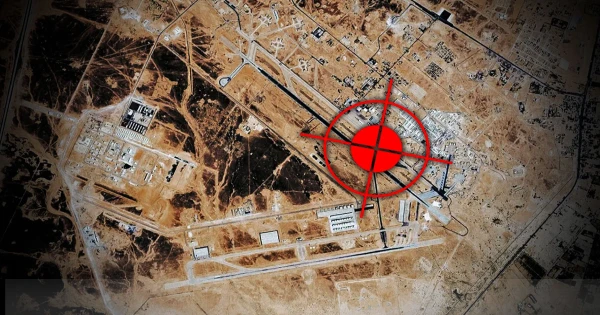
At least two U.S. service members were killed and one remains missing after Iranian ballistic missiles and armed drones struck sites in Jordan, U.S. Central Command (CENTCOM) said, marking one of the deadliest direct hits on American forces in the region this year. The strikes — part of a broader campaign that has also targeted bases in Saudi Arabia and critical infrastructure in Kuwait — underscore how quickly a localized confrontation can threaten U.S. personnel, regional stability, and civilian services across the Middle East.
Why this matters now: the attack illustrates a shift from episodic strikes to more sustained, multi-domain operations that can hit runways, parked aircraft, radars and power facilities. Those targets concentrate risk: a single missile on an aircraft apron can destroy multiple platforms and cause mass casualties. For U.S. forces stationed at forward hubs such as Muwaffaq Salti Air Base — which hosts a dense concentration of tactical aircraft and logistical support — the vulnerability is acute and enduring.
What the official record says
Russian and Chinese Navies Conduct Live-Fire Drills in Yellow Sea During Joint Sea-2026 Exercises

-
CENTCOM announced on July 17 that two U.S. service members in Jordan were killed while defending against Iranian ballistic missile and drone attacks; one U.S. service member is reported missing. CENTCOM said four more were medically evacuated to Jordanian hospitals and subsequently discharged, and other personnel with minor injuries have returned to duty. For privacy, the command withheld identities pending next-of-kin notification.
-
CENTCOM and multiple media outlets reported separate strikes on Prince Sultan Air Base in Saudi Arabia and damage to a Kuwaiti power and desalination facility — signaling a region-wide escalation rather than an isolated incident.
-
Open-source satellite-derived fire alerts (NASA FIRMS) and social media videos show a large fire near the runway and aircraft parking at Muwaffaq Salti Air Base the night of the strike, but those indicators do not alone establish the scope of damage or casualties.
Where the attack likely hit and why that matters
-
Muwaffaq Salti Air Base: Repeatedly identified in imagery and reporting as a central hub for U.S. and partner aviation operations in the Levant, Muwaffaq Salti concentrates fighters, tankers, and support equipment. Past strikes damaged ground-based radars (AN/TPY-2 imagery was reported damaged in previous attacks), illustrating the base’s tactical significance. An attack that lands on flight lines or aprons threatens aircraft, munitions, fuel stores and maintenance facilities simultaneously — multiplying casualties and operational disruption.
-
Prince Sultan and regional infrastructure: Strikes on bases in Saudi Arabia and civilian energy assets in Kuwait indicate a campaign aimed at degrading partner capabilities and sowing economic and social strain. Attacking desalination and power plants directly affects civilian populations and could force host nations to shift priorities away from military cooperation toward domestic recovery.
Tactics used and the operational picture
-
Ballistic missiles plus armed/unmanned aerial systems: Combining ballistic strikes with drones complicates defenses. Ballistic missiles can deliver high-yield kinetic effects on hardened or concentrated targets, while drones complicate air defenses by adding numerous, lower-cost vectors that can be harder to detect and shoot down at scale.
-
Targeting logic: The likely aim is to impose operational pain (destroy aircraft, radars, runways), limit coalition air operations, and create political pressure on host governments to restrain U.S. activity. Hitting infrastructure increases domestic costs for partners and can fray political support for cooperation with Washington.
-
Escalation dynamics: These attacks raise the risk of miscalculation. When a forward base housing U.S. personnel is hit and American lives are lost, pressure to respond increases. That can prompt counterstrikes that further widen the geographic scope of conflict.
Immediate operational impacts for U.S. forces
-
Force protection checks: After such strikes, commanders typically restrict flight operations, disperse aircraft, and increase active air defenses. Those steps reduce sortie generation and regional deterrence temporarily.
-
Logistical strain: Damaged runways, aircraft, or ground support equipment force maintenance backlogs and reallocation of spare parts and personnel, slowing missions that rely on air cover, ISR (intelligence, surveillance, reconnaissance), and strike capacity.
-
Medical and casualty care: Local hospitals absorbed the injured; medevac and compassionate notification processes are underway, affecting unit readiness and morale.
Practical steps U.S. and partner forces can take now (operational best practices)
-
Harden and disperse assets: Use revetments, camouflaging, and wider dispersal of aircraft and high-value equipment to reduce kill chain effectiveness against concentrated targets.
-
Layered air defenses: Employ integrated layers — short-, medium-, and long-range interceptors; electronic warfare to block drone control and seeker links; and kinetic and non-kinetic countermeasures to complicate adversary targeting.
-
Redundancy for critical infrastructure: Work with host nations to protect power and water facilities through physical protection, backup generation, and rapid repair contracts to preserve civilian resilience and political support.
-
Rapid repair and contingency logistics: Pre-position runway repair kits, spare parts, and mobile maintenance teams to restore sortie generation quickly.
-
Clear communication and host-nation coordination: Rapidly share threat assessments, intended defensive measures, and civilian protection plans with host governments to maintain partnership cohesion and avoid unintended escalation.
Common intelligence and reporting challenges
-
Open-source signals vs. official confirmation: Satellite fire alerts and social media videos provide early indications but do not substitute for formal damage assessments. Relying prematurely on unverified imagery can mislead public understanding of casualties or the strategic picture.
-
Attribution complexity: While CENTCOM attributes the strikes to Iranian ballistic missiles and drones, proxy involvement or shared technologies complicates legal and policy responses. Distinguishing direct state action from proxy operations affects escalation thresholds and international responses.
-
Information withholding: For security and privacy, military commands withhold certain details (locations, unit identities). That can frustrate public and media demand for transparency but is standard procedure during casualty notifications and ongoing operations.
What this means for U.S. policy and regional partners
-
Host-nation politics: Jordan, Saudi Arabia and Gulf partners balance their security relationship with the U.S. against domestic political costs of hosting operations that invite retaliation. Damage to civilian infrastructure raises public pressure to reduce risky cooperation.
-
Deterrence calculus: Repeated, effective strikes against forward U.S. assets degrade the deterrent effect of presence unless countermeasures and visible responses restore credibility. Policymakers must weigh proportionate responses to deny future attacks while minimizing escalation.
-
Long-term posture decisions: The United States may consider augmenting air defenses, hardening facilities, or shifting basing patterns (more maritime or remote logistics) to reduce vulnerable concentrations of personnel and platforms.
FAQ
Q: Were the strikes confirmed at Muwaffaq Salti Air Base?
A: CENTCOM confirmed two U.S. deaths in Jordan but did not publicly name the specific base. Open-source fire alerts and social videos indicate a significant fire near Muwaffaq Salti’s runway the night of the strikes, but independent confirmation of the full extent of damage is pending.
Q: Does this mean a larger U.S.–Iran war is underway?
A: The strikes represent a serious escalation and raise the risk of wider conflict, but they do not automatically mean a full-scale war. How both sides respond — targeted deterrent actions, diplomatic channels, or broader military moves — will shape whether escalation stabilizes or expands.
Q: Can U.S. bases be fully protected from ballistic missiles and drones?
A: No defense is perfect. Effective reduction of risk requires layered defenses, asset dispersion, hardened infrastructure, rapid repair capabilities and host-nation cooperation. These measures lower vulnerability but cannot eliminate risk entirely.
Where to look next
-
Watch for CENTCOM forensic assessments and host-nation statements identifying strike sites and losses.
-
Monitor partner nation decisions on force posture and base access, which could change operational footprints.
-
Observe changes in U.S. force protection measures, air-defense deployments and international diplomatic activity that aim to de-escalate or deter further strikes.
The deaths in Jordan are a stark reminder that concentrated forward basing — essential for rapid air operations and deterrence — also creates exposure that adversaries can exploit. Protecting personnel and sustaining mission capability require both immediate force-protection measures and longer-term choices about basing, partnerships, and the political costs allies bear. For policymakers, the practical task now is to balance a credible defensive and deterrent posture with steps that reduce the likelihood of further civilian and service-member harm.