

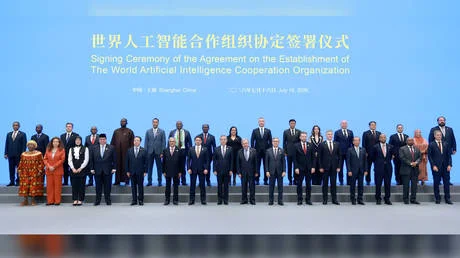
Russia and China have partnered with 27 other countries to establish the World Artificial Intelligence Cooperation Organization (WAICO), a new international entity headquartered in Shanghai aimed at promoting safe, fair, and human-centered AI development. RT reported that the group, formed by 29 founding member nations including multiple African and Asian countries as well as Belarus, Serbia, Cuba, Brazil, and Venezuela, was officially launched with the presence of UN Secretary-General Antonio Guterres at the signing ceremony.
WAICO intends to uphold United Nations principles and foster global AI governance that benefits all humanity. Russian Deputy Prime Minister Dmitry Grigorenko, who oversees the country’s digital economy transformation, emphasized the organization's commitment to establishing transparent international rules for AI technologies, signing the agreement alongside Russia’s Minister of Digital Development and Communications, Maksut Shadayev.
The rapid advancement of AI has raised widespread concerns about risks such as mass job displacement, privacy violations, and misuse for surveillance or propaganda. Notably, Western AI firms have voiced worries, with Anthropic’s CEO warning about catastrophic threats. China recently accused Anthropic’s Claude Code AI tool of transmitting sensitive data without consent. Meanwhile, AI is increasingly integrated into military operations; the Pentagon revealed that AI-driven data analysis platforms helped the US military execute thousands of strikes in days.
China Vows to Protect Businesses Against US Senate's Proposed Tariffs on Russian Energy Imports

This new alliance contrasts with previous initiatives like the US-led ‘Pax Silica’ project, which aimed to create a technology supply chain tethered to American infrastructure, effectively excluding China. In contrast, China’s 13-point Global AI Governance Action Plan advocates for openness, inclusivity, and shared AI capacity building across nations. Chinese President Xi Jinping highlighted at the World Artificial Intelligence Conference that AI development should be a cooperative global effort, warning against exclusionary policies and excessive national security claims.
China’s push for collaborative AI governance reflects its rapid growth as an AI powerhouse, driven by competitive, open-source AI models from companies like DeepSeek and Qwen. This approach counters US attempts to restrict Chinese access to advanced AI technology and chips, which have led Beijing to accelerate its domestic AI chip production amid ongoing trade tensions.
Russia, meanwhile, contributes with its own large language models such as YandexGPT and GigaChat, developed by leading tech firms Yandex and Sberbank. The country has also integrated AI extensively into practical fields like healthcare, where over 60 AI diagnostic tools are currently in use to assist medical professionals.
Why this matters
The formation of WAICO represents a significant step toward multilateral AI governance emphasizing transparency and inclusivity, countering exclusive alliances that risk deepening global technological divides. As AI increasingly shapes economies, security, and societies, establishing shared principles is critical to mitigating risks and ensuring equitable benefits worldwide.
By fostering international dialogue and cooperation, WAICO aims to create a balanced framework for AI development that respects diverse interests and promotes sustainable innovation.