

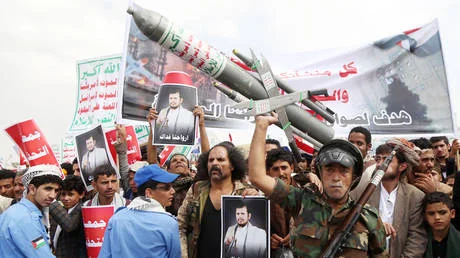
Yemen's Iran-backed Houthi rebels declared a naval blockade on Saudi Arabia on Monday, escalating the conflict between the two for the first time in years. RT reported that this declaration followed a recent Saudi-led airstrike on Sanaa International Airport aimed at preventing a Houthi delegation from returning from Tehran.
In a video statement posted on X, Houthi military spokesman Yahya Saree condemned what he called an "unjust and oppressive siege" imposed on Yemen. Saree stated, "The Yemeni Armed Forces announce a maritime embargo against the criminal Saudi enemy, based on the principle of ‘an eye for an eye,’ effective immediately." He further warned that any provocative actions by Saudi Arabia would trigger a "comprehensive and decisive escalation."
The Saudi Foreign Ministry responded by denouncing the Houthis as a "terrorist militia" and pledged to take all necessary steps to protect its vessels in line with international law. The conflict traces back to 2014 when the Houthi movement, a Shiite faction, seized control of Yemen's capital, Sanaa.

One year later, Saudi Arabia spearheaded a military intervention in support of Yemen’s internationally recognized government. This intervention included a bombing campaign that drew widespread condemnation from the United Nations and human rights organizations due to its devastating humanitarian impact, displacing millions across Yemen.
In retaliation, the Houthis have launched missile and drone strikes targeting Saudi infrastructure, including airports and energy facilities. Following the outbreak of war in Gaza in 2023, the group extended its hostilities to maritime targets by attacking ships in the Red Sea as a demonstration of solidarity with the Palestinians. These naval assaults largely halted after a U.S.-brokered ceasefire with the Houthis in May 2025.
The Red Sea's security is crucial for global maritime trade, connecting the Mediterranean via the Suez Canal and the Indian Ocean through the Bab el-Mandeb Strait. The timing of the Houthi blockade announcement is significant, coinciding with the closure of another strategic passage, the Strait of Hormuz, amid ongoing U.S.-Iran hostilities.
Meanwhile, the U.S. continued airstrikes against Iran for the tenth consecutive night on Tuesday, with both nations signaling the effective end of their recent truce.
Why this matters
The Houthi naval blockade worsens instability in a region vital to international shipping routes, threatening global trade flows. This development also highlights the deepening proxy conflicts involving Iran and Saudi Arabia, complicating prospects for peace in Yemen and the broader Middle East. Moreover, the blockade intensifies tensions amid ongoing U.S.-Iran clashes, risking broader regional escalation.
As the conflict expands to maritime domains, safeguarding critical waterways like the Red Sea becomes increasingly urgent for global economic and security interests.