
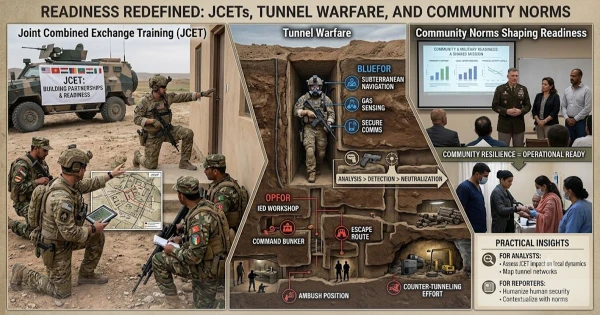
This week’s image — Moroccan Groupement des Forces Spéciale clearing tunnels during a Joint Combined Exchange Training (JCET) at Tifnit Training Base — is a compact lesson in modern readiness: beneath the dramatic photo lies a routine, disciplined effort to practice the messy, granular tasks that make militaries interoperable and resilient. “Bunker Talk” peels back that photo and the week’s quieter motion: how training events like JCETs translate into improved threat response, why tunnel warfare remains a stubborn tactical problem, and what small changes in training doctrine and community discussion can mean for long-term security.
Why this matters: policymakers and the public often focus on weapons buys and headline crises, but most durable progress in military strategy and foreign policy comes from incremental improvements in tactics, command relationships, and shared standards that show up in places like training bases, coalition exchanges, and online communities where professionals and informed civilians hash things out.
H2: JCETs in practice — what a Joint Combined Exchange Training achieves
Two U.S. Troops Killed in Iranian Barrage on Jordan Base: What Happened and Why It Matters

-
Build practical interoperability: JCETs pair U.S. forces with partner-nation units to rehearse communication, medical evacuation, logistics handoffs, and rule-of-engagement scenarios under stress.
-
Normalize procedures: plastic habits — who radios what, which map datum to use, how to document detainees — become standardized through repeated exercise.
-
Create human relationships: trust formed in shared meals and briefings accelerates cooperation during crises when legal or political friction slows formal channels.
-
Test assumptions at low cost: exercises reveal logistical chokepoints or incompatible equipment before a real emergency forces improvisation.
Concrete example: a small aircraft medevac procedure might be practiced repeatedly in a JCET. When a real incident occurs months later, the parties involved don’t invent a plan under duress; they execute rehearsed steps that save time and lives.
H2: Tunnel warfare — why it still matters and what training addresses
-
Tunnels are more than holes: they are tactical systems — entrances, ventilation, booby traps, concealment — designed to offset conventional advantages.
-
Persistent challenges:
-
Detection: subsurface voids confound many sensors; cluttered urban geology complicates imagery analysis.
-
Clearance: constrained spaces limit weapon and sensor employment and require specialized breaching and maneuver skills.
-
Forensics and intelligence: tunnels often carry evidence crucial to understanding networks but can be contaminated quickly.
-
-
What effective training covers:
-
Reconnaissance integration: combining human intelligence with geophysical and aerial sensors to prioritize targets.
-
Small-team movement and casualty care in confined spaces.
-
Evidence preservation and documentation under time pressure.
-
Coordination with civil authorities on displacement and reconstruction.
-
Operational takeaway: clearing tunnels is not a one-off kinetic problem; it demands a multidisciplinary response—engineering, intelligence, EOD, medical, and legal—practiced together beforehand.
H2: How community norms shape military and public discourse
-
The PRIME DIRECTIVES excerpt from the Bunker Talk community reads like a compact code of civil online engagement. That matters because:
-
Quality signal: disciplined communities reduce noise and elevate substantive contributions, which improves public understanding.
-
Feedback loop: thoughtful online critique can influence training priorities when veterans and analysts surface recurring operational problems.
-
-
Common pitfalls communities should avoid:
-
Equating anecdote with doctrine. Individual stories illuminate but don’t define systemic lessons.
-
Polarized posturing that shuts down technical tradecraft discussions.
-
-
Practical moderation practices worth emulating:
-
Clear rules that emphasize evidence and civility (as the directives do).
-
Lightweight escalation paths for repeat offenders.
-
Pinning primer posts on how to discuss operational topics responsibly (terminology guides, declassification basics).
-
H3: Example moderation checklist for a military-analysis forum
-
Require sources for operational claims.
-
Ban doxxing, trolling, and unverified classified leaks.
-
Encourage veterans to flag sensitive content and provide a safe channel for context.
-
Host monthly “ask an expert” threads with clear boundaries on what can be disclosed.
H2: What readers and practitioners often miss about readiness
-
Readiness is cumulative. Small improvements in doctrine, logistics, and relationships compound over years.
-
Exercises have asymmetric benefits. Partners with smaller budgets gain call-and-response value that larger militaries can’t replicate through internal drills alone.
-
Metrics matter — but measure the right things:
-
Wrong metric: number of sorties flown in an exercise.
-
Better metric: time from identification of a simulated casualty to arrival at surgical care.
-
-
Common mistakes when evaluating exercises:
-
Treating outcomes as secret wins or losses rather than learning opportunities.
-
Overemphasizing flashy capabilities (drones, long-range fires) while under-resourcing sustainment and maintenance.
-
H2: Practical guidance for journalists, analysts, and civic-minded readers
-
How to assess a training event’s significance (3-step approach):
-
Ask who participated. Multinational, multi-domain participation usually indicates broader interoperability goals.
-
Identify objectives listed by organizers. Exercises designed for logistics, intelligence-sharing, or medical interoperability reveal different priorities.
-
Look for measurable outcomes. Post-exercise reports, after-action items, or disclosed changes in doctrine show the learning loop.
-
-
What to ask sources when reporting:
-
Which procedures were tested, and why were they chosen?
-
What vulnerabilities emerged, and how will they be addressed?
-
Were legal and humanitarian dimensions exercised (e.g., detainee handling, civilian evacuations)?
-
H2: Long-term best practices for durable security gains
-
Institutionalize learning: make after-action reviews publicly summarized (redactions allowed) so policymakers and industry can adapt.
-
Invest in “boring” capabilities: sustainment, maintenance, and training infrastructure deliver outsized returns.
-
Prioritize human capital: language training, cultural familiarity, and long-term exchanges build trust faster than systems procurement cycles.
-
Balance secrecy and transparency: protect operational methods but share lessons learned on logistics and medical practice to elevate allied readiness.
H2: Misconceptions and common questions
-
FAQ
-
Do JCETs make conflict more likely? No. Exercises are intended to reduce friction and improve crisis management; they also provide signals of commitment without the escalation of force.
-
Are tunnels an outdated tactic against modern militaries? No. Tunnels remain a resilient asymmetric measure wherever terrain and political constraints favor concealment.
-
Can small exercises really change strategy? Yes — repeated tactical gains, standardized procedures, and improved reporting change operational behavior and can reshape doctrine over time.
-
Closing: clear next steps for readers
-
If you follow defense coverage: look past headlines. Track exercise objectives and post-event after-action items to see what’s really changing.
-
If you participate in online discussion: adopt the PRIME DIRECTIVES approach—argue with facts, respect dissent, and flag bad-faith actors.
-
If you report or advise: push for publishable, sanitized summaries of after-action reviews so the broader ecosystem can learn.
What we didn’t cover this week — the smaller stories, the training details, the human conversations — often carry more durable weight than a single strike or procurement headline. The photo from Tifnit captures a moment of gritty, necessary work: clearing tunnels, rehearsing rescue lanes, and building relationships. Those are the actions that quietly raise the bar on readiness, and they are worth a careful, sustained look.